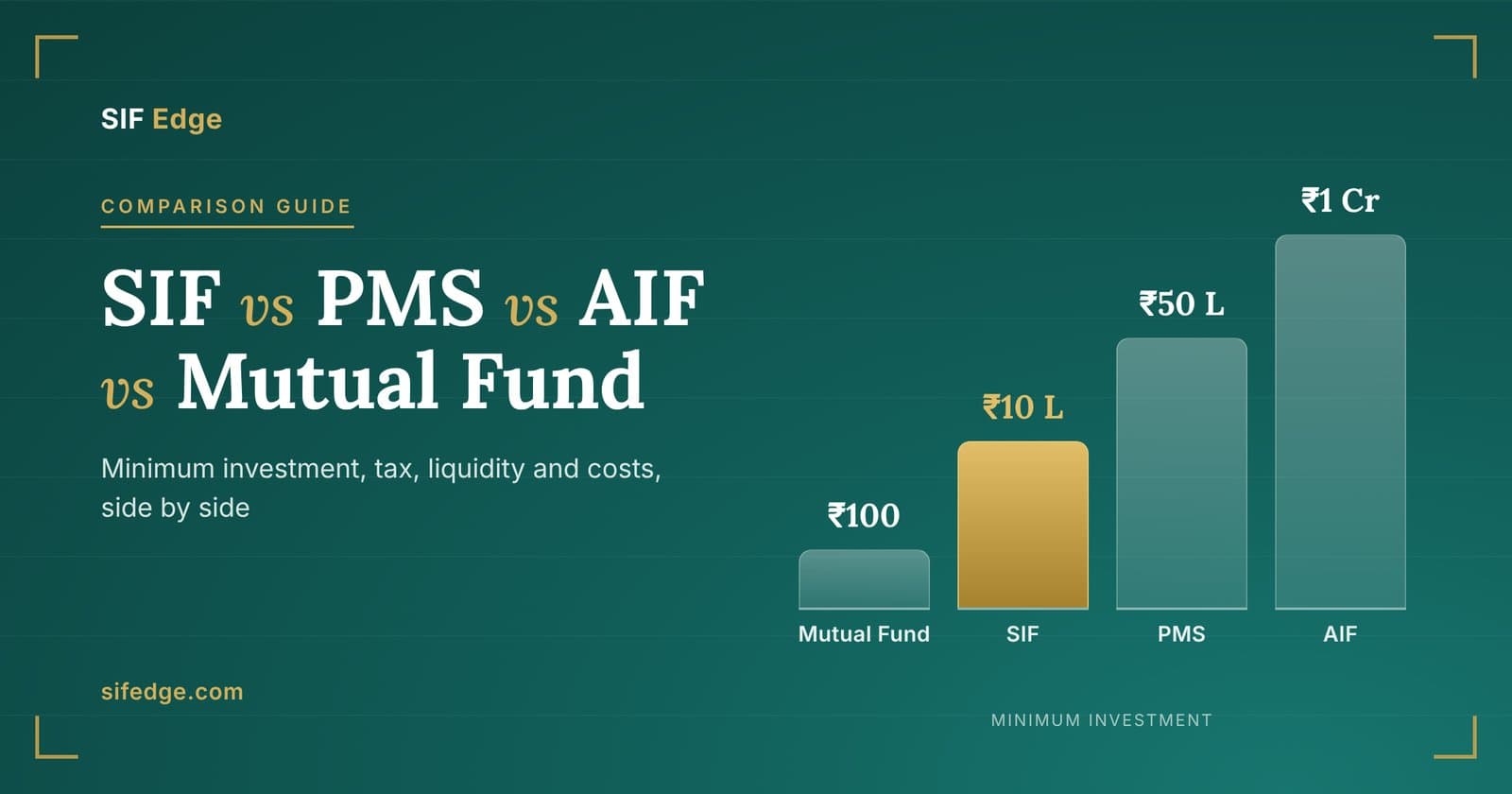
Mutual funds, SIFs, PMS and AIFs are all regulated by SEBI, but they differ in important ways: how investments are held, how and when gains are taxed, and how easily investors can exit.
New to SIFs? Start with our guide to understanding SIFs.
Quick comparison
| Feature | Mutual fund | SIF | PMS | AIF (Cat. III) |
|---|---|---|---|---|
| Minimum investment | ₹100 to ₹5,000 | ₹10 lakh | ₹50 lakh | ₹1 crore |
| Unhedged shorts | Not used | Up to 25% | Generally not permitted | Permitted |
| Leverage | No | No | No | Up to 2x NAV |
| Tax | When you redeem | When you redeem | On every sale | At fund level |
| Exit | Any business day, subject to any scheme-related exit load | Daily to weekly, subject to any scheme-related exit load | Any time, subject to exit load | Periodic windows, can be subject to lock-ins |
| Costs | TER | TER | Fixed and/or variable fee | Fee plus carry |
| Portfolio disclosure | Monthly | Alternate months | The securities remain in the investor’s account | Private |
Minimum investment and eligibility
The minimum investment is ₹10 lakh for a SIF, calculated across the eligible strategies of the same AMC at the PAN level. The minimum for PMS is ₹50 lakh, while Category III AIFs generally require ₹1 crore. Exemptions are applicable for accredited investors, subject to the relevant regulatory conditions.
Strategy flexibility and use of derivatives
SIFs offer seven defined investment strategies and can take unhedged short positions of up to 25% of net assets without borrowing. PMS managers can use derivatives for hedging, but cannot leverage client portfolios. Category III AIFs are permitted to use leverage, subject to the applicable limit of up to 2x NAV.
How are they taxed?
Mutual funds and SIFs are taxed when investors redeem their units. For equity-oriented funds, the rates are 20% on short-term capital gains and 12.5% on long-term capital gains exceeding ₹1.25 lakh in a financial year.
In a PMS, capital gains are recognised when the manager sells securities in the investor’s portfolio. Category III AIF taxation follows a different framework and depends on the applicable structure and tax provisions.
PMS vs SIF: tax comparison
Illustration: ₹50 lakh investment, ₹6 lakh gain, redemption after 13 months.
| Particulars | PMS | Equity-oriented SIF |
|---|---|---|
| Short-term gain on shares sold by the manager / fund | ₹3,00,000 | -- |
| Tax on STCG | ₹60,000 (20%) | -- |
| Long-term gain (on redemption) | ₹3,00,000 | ₹6,00,000 |
| Less: Section 112A exemption | ₹1,25,000 | ₹1,25,000 |
| Tax on LTCG | ₹21,875 (12.5%) | ₹59,375 (12.5%) |
| Total tax | ₹81,875 | ₹59,375 |
| Post-tax gain | ₹5,18,125 | ₹5,40,625 |
What this shows: Illustrative tax difference of ₹22,500 in favour of the SIF.
Assumptions: PMS gains comprise ₹3 lakh STCG and ₹3 lakh LTCG. The SIF gain qualifies fully as LTCG under equity-oriented fund rules, as units are held for more than 12 months.
Read our SIF taxation guide for more details.
Liquidity and redemption
Mutual funds offer redemption on business days, subject to the scheme’s terms. SIF redemption frequency depends on the strategy: equity strategies can offer daily, hybrid strategies twice-weekly and debt strategies weekly redemption.
PMS investors can request an exit in accordance with the agreement and applicable rules; exit loads may apply.
AIFs generally offer exits through specified windows, as set out in their fund documents.
Costs and fee structures
Based on AMFI data as of 12 November 2026, the median SIF total expense ratio (TER) was 1.63% for direct plans, and 1.96% for direct equity strategies. PMS fees may be fixed, performance-linked or a combination of both, in addition to applicable GST and brokerage.
Comparing SIF and PMS costs
Illustration based on a ₹50 lakh investment and 15% gross return.
| Particulars | SIF Direct (1.96% TER) | PMS (2% fixed)* | PMS (1% + 15% above 10%)* |
|---|---|---|---|
| Initial investment | ₹50,00,000 | ₹50,00,000 | ₹50,00,000 |
| Gross return | 15% | 15% | 15% |
| Gross gain | ₹7,50,000 | ₹7,50,000 | ₹7,50,000 |
| Fee calculation | 1.96% × ₹50L = ₹98,000 | 2% × ₹50L = ₹1,00,000 + 18% GST = ₹18,000 | 1% × ₹50L = ₹50,000; 15% × (₹7.5L − ₹5L) = ₹37,500; subtotal ₹87,500 + GST ₹15,750 |
| Total fees | ₹98,000 | ₹1,18,000 | ₹1,03,250 |
| Net gain before tax | ₹6,52,000 | ₹6,32,000 | ₹6,46,750 |
What this shows: At a 15% gross return, the SIF direct-plan expense is ₹98,000. Under the illustrated PMS fee structures, total fees are ₹1,18,000 for the 2% fixed-fee model and ₹1,03,250 for the performance-linked model. PMS fees include GST but exclude brokerage.
Assumptions: SIF direct TER is applied to ₹50 lakh for illustration; a regular plan TER will result in higher fees. PMS fees are calculated on ₹50 lakh; the performance fee is 15% of returns above a 10% hurdle (₹5 lakh). GST at 18% is applied to PMS fees. Brokerage and other transaction costs are excluded. *Actual fee bases and terms depend on the PMS agreement; TER affects NAV and may vary.
Regulation and portfolio disclosure
All four structures operate within SEBI’s regulatory framework, but under different rules.
SIFs follow the mutual fund framework and are required to disclose portfolios every alternate month.
PMS investors receive details of their own portfolios and have personal logins to view their portfolio in real time.
AIFs are privately pooled investment vehicles. They are more opaque as a structure and are recommended for very sophisticated and ultra-HNI investors only.
Which investment structure may suit which investor?
As a broad illustration and not a personal recommendation: mutual funds can form the core of most Indian financial portfolios. A SIF may be considered as part of a core or satellite allocation by investors who understand its strategy and risks.
PMS may appeal to investors seeking a separately managed portfolio, while Category III AIFs may suit investors who understand their more complex strategies and risk profile. Minimum investment thresholds are only one part of the suitability assessment.
Conclusion
Mutual funds generally offer simplicity, diversification and liquidity. SIFs add greater flexibility, including permitted long-short strategies, while retaining the mutual fund structure.
PMS offers an individually managed portfolio, whereas Category III AIFs provide access to privately pooled strategies that may use leverage. The right choice depends on the investor’s objectives, liquidity needs, risk capacity, costs and tax position.
Compare live SIFs on risk, returns and fund manager in the SIF fund comparison section, or see how the products differ in our SIF vs mutual fund guide.
FAQs: SIF vs PMS vs AIF vs Mutual Funds
What is the difference between SIF and mutual funds?
SIFs operate under the mutual fund framework but offer greater investment flexibility. Unlike traditional mutual funds, SIFs can take unhedged short positions of up to 25% of net assets through permitted derivatives. They also have a minimum investment requirement of ₹10 lakh.
How is SIF different from PMS in India?
A SIF pools money from multiple investors and issues units, while a PMS manages a separate portfolio for each investor, with securities held in the investor’s name. SIFs follow the mutual fund framework, whereas PMS offers greater portfolio-level customisation.
What is the difference between SIF and Category III AIF?
Both SIFs and Category III AIFs offer long-short investment strategies. The key differences are regulation, minimum investment and leverage. SIFs operate under the mutual fund framework, have a ₹10 lakh minimum and cannot use leverage. Category III AIFs have a ₹1 crore minimum and can use leverage within SEBI limits.
What is the minimum investment required for SIF, PMS and AIF?
The minimum investment is ₹10 lakh for SIF, ₹50 lakh for PMS and ₹1 crore for AIF. For SIFs, the ₹10 lakh requirement is aggregated across eligible strategies of the same AMC at the investor’s PAN level.
How are SIF returns taxed in India?
SIF taxation depends on the fund’s tax classification. Equity-oriented SIFs follow the capital gains tax treatment applicable to equity-oriented mutual funds. Certain hybrids also enjoy 12.5% LTCG taxation after one year. Tax is calculated when the investor redeems units, rather than on every underlying portfolio transaction.
Is SIF more tax-efficient than PMS?
SIFs offer a mutual fund-like tax structure. Investors are taxed when they redeem their units, whereas PMS investors are taxed on realised gains whenever securities are sold within their portfolio. This difference can result in a lower tax outgo for SIF investors, depending on the nature and timing of gains.
Can SIFs take short positions or use derivatives?
Yes. SIFs can use derivatives for hedging and other permitted investment strategies. They can also take unhedged short positions of up to 25% of net assets. This allows fund managers to take positions on stocks they expect to decline.
Can investors withdraw money from SIFs at any time?
Redemption frequency depends on the SIF strategy. Equity strategies offer daily redemption, hybrid strategies offer at least twice-weekly redemption, and debt strategies offer at least weekly redemption. Exit loads, notice periods and other conditions apply as specified in the scheme documents.
How frequently do SIFs disclose their portfolios?
SIFs disclose their portfolios every alternate month, covering February, April, June, August, October and December. The portfolio, including derivative positions, is published on the AMC and AMFI websites within 10 days of the end of the relevant month.
Which is better for investors: SIF, PMS or mutual funds?
There is no single better product. Mutual funds suit investors looking for conventional diversified strategies. SIFs offer greater flexibility through long-short strategies, while PMS provides individual portfolio management and customisation. The right choice depends on portfolio size, risk appetite, investment horizon and liquidity requirements.
Who should consider investing in a SIF?
SIFs are suited to investors with an established core investment portfolio, a minimum investment capacity of ₹10 lakh and an understanding of market risks. They are particularly relevant for investors looking beyond conventional long-only mutual fund strategies and seeking different approaches to portfolio management.
Are SIFs riskier than traditional mutual funds?
SIFs have greater investment flexibility, including the ability to take unhedged short positions and use derivatives. This creates a different risk-return profile compared with traditional mutual funds. The actual risk depends on the strategy, portfolio construction, derivative exposure and fund manager’s investment approach.
Disclaimer: For educational purposes only. Specialized Investment Funds (SIFs) in India carry relatively higher risk compared to traditional mutual funds. This article is not investment, tax or legal advice. All investments are subject to market risks. Investors should read the relevant scheme or fund documents and consult an appropriately qualified professional where required.