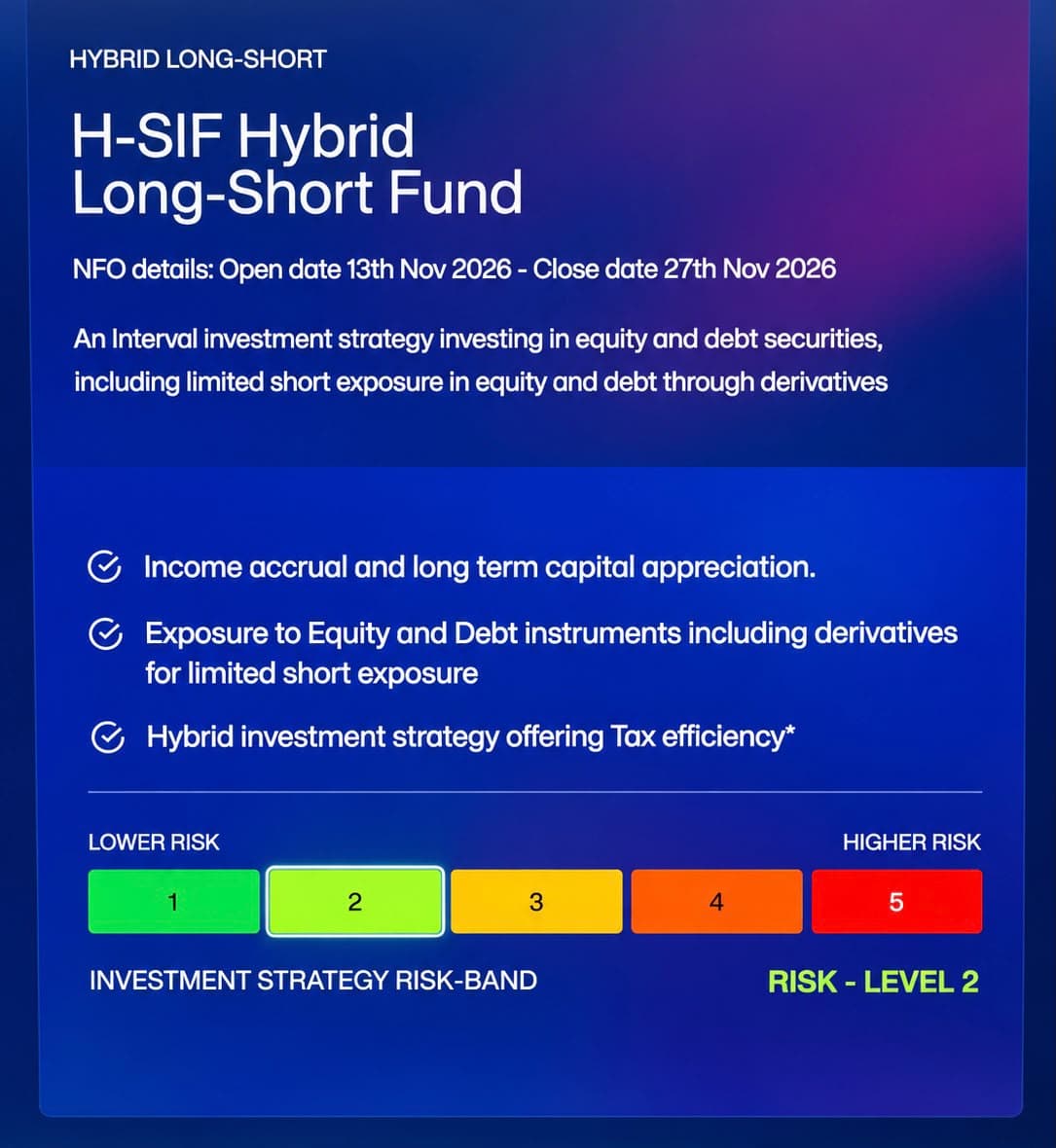
HDFC Mutual Fund’s H-SIF Hybrid Long-Short Fund brings debt, arbitrage, equity, special situations, listed InvITs and derivative strategies into one interval-based SIF. The New Fund Offer is scheduled from 13 November to 27 November 2026.
HDFC H-SIF NFO: the key details
| Fund | H-SIF Hybrid Long-Short Fund |
|---|---|
| Fund house | HDFC Mutual Fund |
| Strategy category | Hybrid Long-Short |
| Structure | Interval investment strategy |
| NFO dates | 13–27 November 2026 |
| NFO price | ₹10 per unit |
| Reopening date shown | 8 December 2026 |
| Investment strategy risk band | Level 2 |
| Benchmark | Nifty 50 Hybrid Composite Debt 50:50 Index |
| Plans and options | Regular and Direct; Growth and IDCW |
| Minimum threshold | ₹10 lakh |
What does the H-SIF Hybrid Long-Short Fund invest in?
As a Specialised Investment Fund is not a conventional hybrid fund, its investment approach combines several distinct sources of return, each serving a different role.
Debt and money-market instruments
The strategy can invest across government securities, State Development Loans, Treasury Bills and other debt instruments across maturities and credit ratings. This part of the portfolio is intended to contribute income accrual and portfolio stability.
Arbitrage
Arbitrage positions would capture the price differences between related securities or market positions via hedged trades. Returns depend on the availability of spreads, execution and transaction costs. Investors must note that arbitrage is usually a net positive trade, but it is not a fixed-return instrument.
Equity and special situations
The strategy can take long equity positions and pursue opportunities in company events involving IPOs, mergers, buybacks, open offers and other special situations. These create scope for sizable capital appreciation when the strategy AUM is small.
Listed InvITs
The strategy can invest in listed Infrastructure Investment Trust units. InvITs provide exposure to infrastructure assets and their cash flows, but their market prices and distributions remain subject to interest rates, asset performance, leverage and market liquidity.
Derivatives and short exposure
Derivatives can be used for hedging, portfolio management and short exposure of up to 25% of net assets. A short position can benefit when the underlying security falls, but it can also participate less in the upside when the security price rises. Derivatives introduce additional valuation, liquidity, counterparty and execution risks.
Why is decoding important?
In H-SIF, debt, arbitrage and InvIT exposure are positioned around income accrual and portfolio construction.
Long equity, special situations and derivative strategies provide avenues for capital appreciation and tactical positioning. The portfolio is designed to work across more than one market opportunity.
Risk band and benchmark
The published investment strategy risk band is Level 2. Its benchmark is the Nifty 50 Hybrid Composite Debt 50:50 Index. These are reference points for understanding and comparing the strategy; the risk band may change post NFO.
Minimum investment: ₹10 lakh
The minimum investment threshold is ₹10 lakh in aggregate across the investment strategies offered under the SIF, measured at the investor’s PAN level.
Liquidity, costs and exit conditions
This is an interval strategy, not an open-ended fund with an assumption of daily redemption.
Who should consider this SIF?
The strategy is relevant for investors who understand hybrid and derivative-based investing, have a medium- to long-term investment horizon, can accommodate interval liquidity and are comfortable with some amount of volatility.
It can be evaluated as one allocation within a diversified portfolio. It is not designed for investors seeking assured income, daily liquidity or a simple substitute for a conventional fixed deposit or debt fund.
Frequently asked questions
When does the HDFC H-SIF Hybrid Long-Short Fund NFO open and close?
The NFO is scheduled to open on 13 November 2026 and close on 27 November 2026.
What is the minimum investment in H-SIF?
The minimum investment threshold is ₹10 lakh in aggregate across the SIF’s strategies at PAN level, subject to specified regulatory exceptions.
What is the benchmark for the H-SIF Hybrid Long-Short Fund?
The published benchmark is the Nifty 50 Hybrid Composite Debt 50:50 Index.
What does 25% unhedged short exposure mean?
The strategy description permits unhedged short exposure up to 25% of net assets. A short position can lose money if the underlying security rises.
Does the fund offer daily redemption?
No. It is an interval investment strategy.
Does a Level 2 risk band mean the investment is safe?
No. The risk band is an indicator, not a guarantee of capital protection or a measure of every risk in the portfolio.
Does the ₹10 NFO price make the fund cheap?
No. The NFO price is simply the offer price per unit and does not indicate valuation or future returns.
The larger point
The H-SIF Hybrid Long-Short Fund brings a broader toolkit than a conventional hybrid fund. There are a few other live SIF schemes in the same ARBITRAGE+ category (not a SEBI-defined category; used only to explain better).
The decision should come down to portfolio fit, risk understanding, costs and the ability to live with the strategy’s interval liquidity. A new fund offer has no live scheme performance history. Investors are assessing the mandate and the investment process, not a track record.
SIFedge.com
Disclaimer: Investments in SIFs involve market risk, including possible loss of capital, liquidity risk and volatility. Read all scheme-related documents carefully before investing. This article is for general information and education; it is not investment advice.